Akhenaten was the pharaoh who tried to remake Egypt's religion, and Egypt then tried to forget him
Akhenaten was the pharaoh who tried to remake Egypt's religion, and Egypt then tried to forget him
Akhenaten was a pharaoh of the 18th Dynasty who ruled for about seventeen years in the mid fourteenth century BCE. He came to the throne as Amenhotep IV, renamed himself for the Aten, the visible disk of the sun, starved the temples of the other gods and built a new capital at Amarna in Middle Egypt. Whether that was monotheism is still argued. His wife was Nefertiti, his probable son was Tutankhamun, and within a generation of his death his city was abandoned, his statues smashed and his name cut from the king lists. You can still walk his capital, read his boundary stelae in the cliffs and stand under his colossal statues in Cairo and Luxor. Here is the story, and how to see it.
From Amenhotep IV to Akhenaten
He was a younger son of Amenhotep III and Queen Tiye. His older brother, the crown prince Thutmose, died first, so the throne passed to a boy nobody had prepared for it.
He was crowned at Thebes as Amenhotep, a name that means Amun is satisfied, and his first buildings went up at Karnak, inside Amun's own domain. Even those were strange: open-air sun courts east of the main temple, built from small standardized blocks so they could rise fast, with the king carved in a style nobody had seen before.
Around his fifth year he changed his name to Akhenaten, usually translated as effective for the Aten. Amun vanished from his titles.
Egyptologists place the reign roughly between 1353 and 1336 BCE; different chronologies shift those numbers by a decade. The length is not in doubt, because wine jar labels found at Amarna run to his year seventeen. What is unsettled is whether he shared the throne with his father for some years first.
The Aten, and whether this was monotheism
The Aten was not a new god. The word means the sun disk, and Amenhotep III had already used it as a name for the sun and for himself. What Akhenaten did was strip everything else away: no human or animal form, no myth, no divine family. The Aten appears only as a disk whose rays end in small hands, holding the ankh, the sign of life, to the noses of the king and queen. Never to anyone else.
The case for calling it monotheism is real. He shut the temples of Amun and sent workmen across Egypt to chisel Amun's name off monuments, including his own father's. The Great Hymn to the Aten, carved in the tomb of the courtier Ay at Amarna, describes a single creator who made every country, every language and every skin color.
The case against is just as real. Ordinary people at Amarna prayed not to the Aten but to the royal family, whose images sat in household shrines in the city's villas, and the king was the only channel between the sun and everyone else. Many specialists therefore prefer the word henotheism, one god raised above the rest, or read the whole episode as a political move against the wealth of the Amun priesthood at Thebes.
Freud's essay that imagined Moses as a follower of Akhenaten is a literary hypothesis with no documentary support. What is safe to say is that this was the earliest attempt we know of to make one god exclusive, and that it did not survive him. Our guide to the pharaohs as god kings of the Nile explains the tradition he broke with.
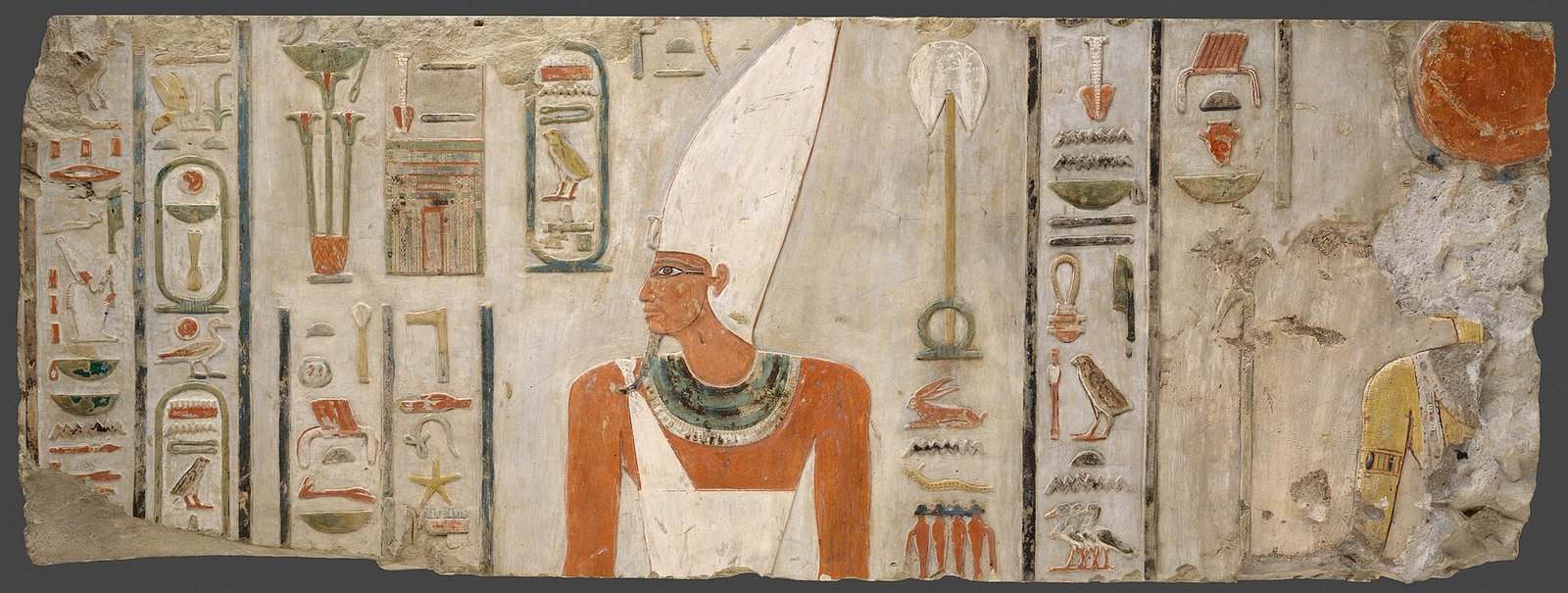
Akhetaten, a capital built from nothing
In his fifth year he marked out a site on the east bank of the Nile in Middle Egypt, in what is now Minya governorate, where the sun rises through a notch in the cliffs shaped like the hieroglyph for horizon. He named the city Akhetaten, horizon of the Aten. Today it is called Amarna. The ground had never been built on, which was the point: it belonged to no god and no man.
He fixed its limits with boundary stelae cut into the cliffs on both banks, more than a dozen in total, each showing the royal family under the rays above a text in which the king swears never to push the city past those marks. Stela U, beside the road that climbs to the royal tomb, is the one most visitors stand in front of.
The city went up in a few years, mostly in mud brick: palaces in the north, the Central City with the Great and Small Aten Temples, the King's House and the records office, then the residential quarters and, out in the desert, a walled workmen's village. The temples had no roofs; the altars stood under the sun itself.
Because it was abandoned within about fifteen years of his death and nobody built on top of it, Amarna is the best preserved city plan of pharaonic Egypt. Thebes and Memphis lie under twenty later layers. Amarna lies under sand.
The Amarna art style and the elongated bodies
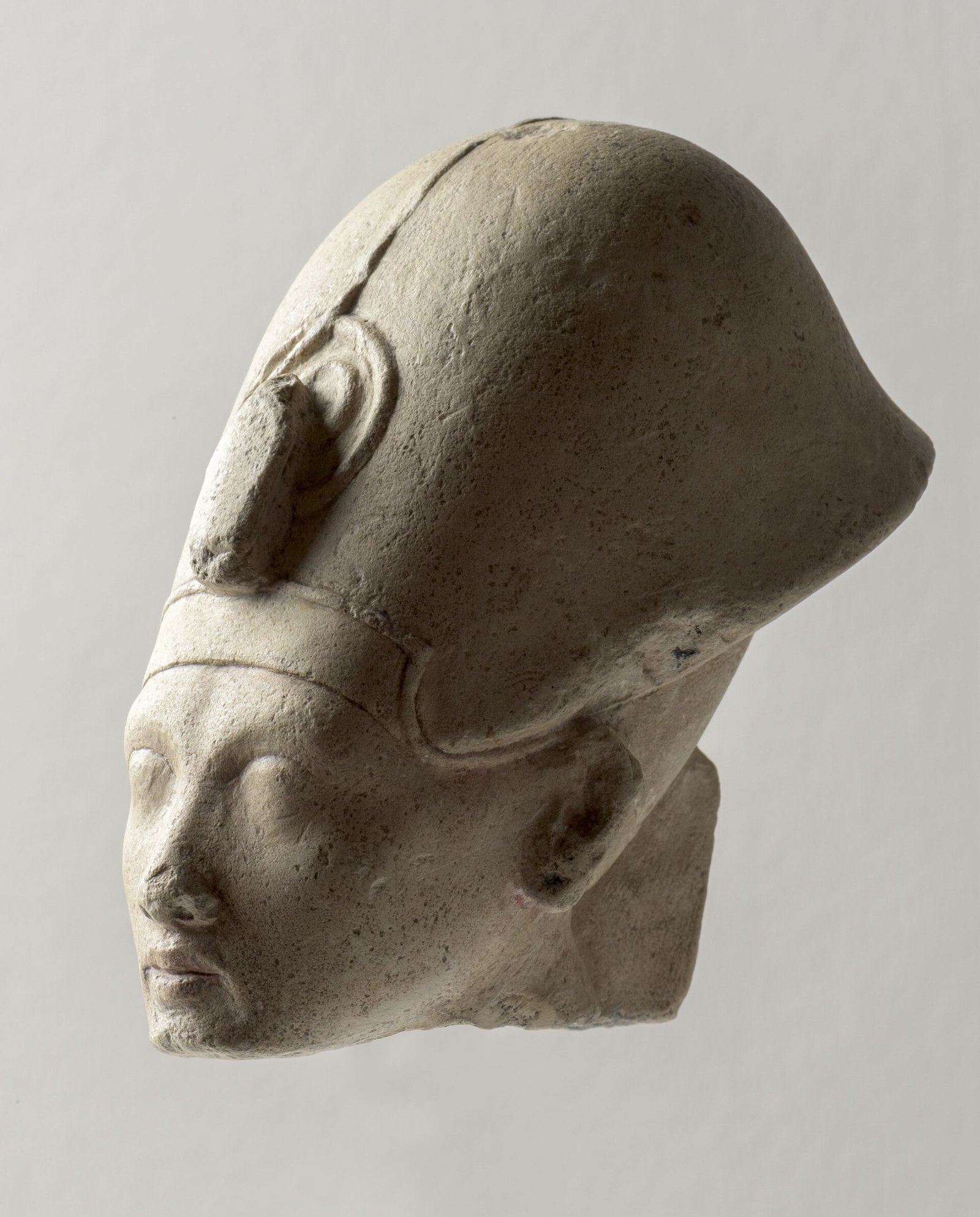
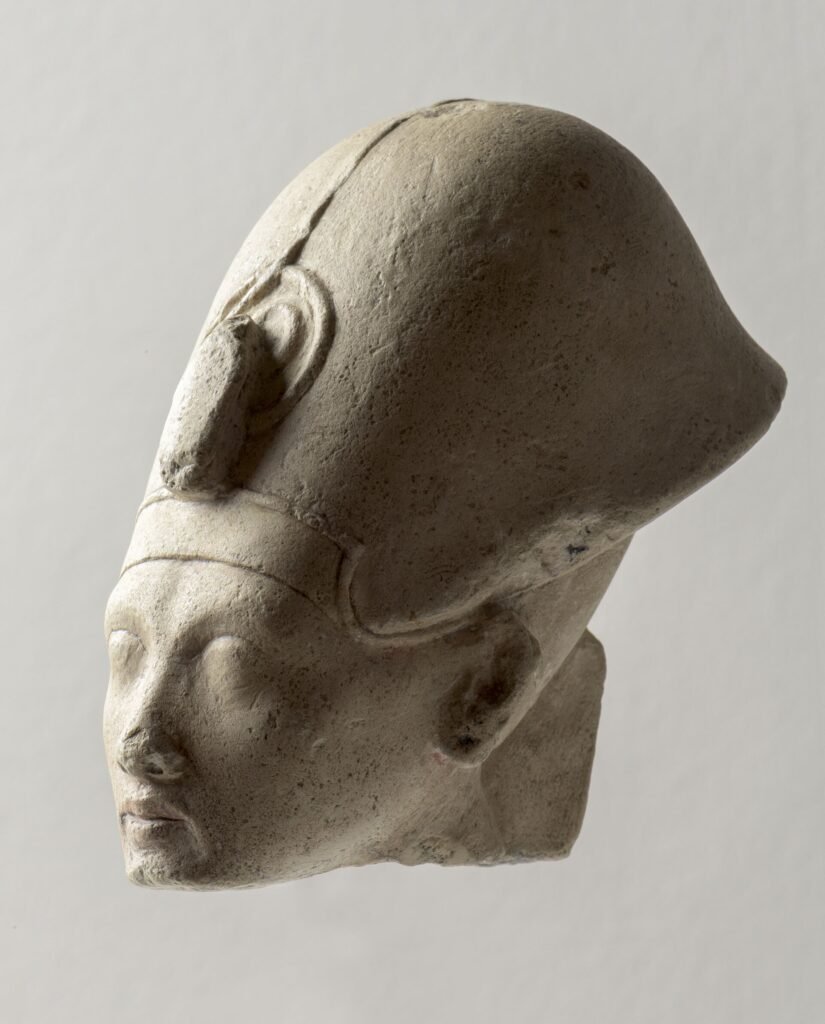
For fifteen centuries Egyptian art had shown the king in a fixed canon: broad shoulders, an athletic torso, a calm and ageless face. Under Akhenaten that canon broke. His colossal statues from Karnak, now in Cairo and Luxor, give him a long narrow face, thick lips, a drooping jaw, a sunken chest, a soft belly and wide hips on thin limbs.
Medical explanations have been proposed for over a century, and they are theories, not findings. Marfan syndrome, Frohlich's syndrome and familial gynecomastia have all had advocates. The published genetic and CT studies of the family's mummies did not find evidence for any of them.
The reading most Egyptologists hold today is theological. If the king is the earthly image of a god who gives life to everything, he is shown with the attributes of both sexes and of no particular age. The style softened after the move to Amarna: the painted bust of Nefertiti, found in the workshop of the sculptor Thutmose in 1912 and now in Berlin, is naturalistic, not exaggerated.
What is certainly new is the subject matter. The royal family is shown kissing, eating, bouncing the girls on their laps and, in the royal tomb, weeping over a dead daughter. Before Amarna nothing like this was carved on an official wall, and after Amarna it never appears again.
Nefertiti and the six daughters
Nefertiti's name means the beautiful one has come. No monument names her parents; the courtier Ay, who later became pharaoh, is often proposed as her father, but that is an inference. She held a position no Egyptian queen had held before: she is shown smiting foreign enemies, a pose reserved for kings, and in one of the Karnak sun temples she appears more often than her husband.
The couple had six daughters: Meritaten, Meketaten, Ankhesenpaaten, Neferneferuaten the younger, Neferneferure and Setepenre. Meketaten died around year fourteen and is the child mourned in the royal tomb. Ankhesenpaaten later became Ankhesenamun and married Tutankhamun. No son of Nefertiti is recorded anywhere.
After about year twelve Nefertiti fades from the record. A quarry inscription published in 2012 shows her still queen in year sixteen. Many Egyptologists now think she ruled briefly as a pharaoh under the name Neferneferuaten, but that is disputed, and her tomb has never been found. We have a separate guide to Queen Nefertiti and the search for her tomb.
The Amarna letters
In 1887 a village woman digging in the ruins for sebakh, decayed mud brick used as fertilizer, turned up baked clay tablets covered in wedge-shaped signs. Scholars eventually gathered close to four hundred, written in Akkadian cuneiform, the diplomatic language of the Late Bronze Age.
The great kings of Babylon, Assyria, Mitanni, the Hittites and Cyprus write to pharaoh as brother to brother, negotiating marriages, demanding gold and complaining about the last gift. The vassal rulers of Canaan and Syria, the mayors of Byblos, Jerusalem, Megiddo and Tyre, beg for archers against each other and against raiders called the Habiru, and often complain that nobody in Egypt answers.
The archive runs from the last years of Amenhotep III into the first of Tutankhamun and is the best window that exists onto the international politics of the age. Most tablets are in Berlin and the British Museum. A group is kept in the Egyptian Museum in Cairo.
The end of the reign and the erasure by later kings
Akhenaten died in or just after his seventeenth year, of causes unknown. A brief king called Smenkhkare appears, then a female pharaoh named Neferneferuaten, then a boy of about nine crowned as Tutankhaten. Within a few years the boy's name had become Tutankhamun, and the court had returned to Thebes and Memphis. Amarna was left to the wind.
The boy's link to Akhenaten is close but not quite closed. The genetic study of the royal mummies published in 2010 identified the body from tomb KV55 in the Valley of the Kings as Tutankhamun's father and as a son of Amenhotep III and Tiye. Most Egyptologists take that body to be Akhenaten, since its coffin had the name deliberately cut out. Others argue the skeleton is too young and propose Smenkhkare.
Horemheb, the general who became pharaoh after Ay, and the Ramesside kings after him did the demolition thoroughly. Akhenaten's temples at Karnak and Amarna were taken apart block by block, and the blocks, called talatat from an Arabic word for three, were packed as fill inside new pylons at Karnak. His statues were broken, his name chiseled out, and the king list at Abydos jumps from Amenhotep III straight to Horemheb, as if the four Amarna kings had never existed. A later legal text calls him the criminal of Akhetaten.
The erasure held for three thousand years, until Napoleon's scholars mapped the ruins, Petrie dug the palace floors in the 1890s, and a German team lifted the bust of Nefertiti out of the sand in 1912.
What survives to see today
More survives than most travelers expect.
| Place | What you see | Where |
|---|---|---|
| Tell el Amarna | Boundary stelae, North Palace, royal tomb, nobles' tombs, temple foundations, workmen's village | East bank, Minya governorate |
| Luxor Museum | Reconstructed talatat wall and colossal statues of Akhenaten from Karnak | Luxor Corniche |
| Egyptian Museum | Amarna gallery: colossi, family stela, unfinished head of Nefertiti, KV55 coffin | Tahrir Square, Cairo |
| Karnak Temple | The Ninth Pylon, filled with talatat, and rows of recovered blocks | Luxor, east bank |
| Grand Egyptian Museum | The complete Tutankhamun collection | Giza |
Amarna itself
Start with Stela U at the mouth of the royal wadi, where the family is carved above the oath text. The North Palace has mud brick walls to shoulder height around a garden court. The royal tomb lies several miles up a dry valley east of the city, unfinished, with the mourning scenes for Meketaten in a side suite. The northern tombs of Huya, Meryre, Panehesy and Ahmes have the best surviving Aten scenes, the southern tomb of Ay holds the Great Hymn, and the visitor center has a model of the whole city.
The Luxor Museum talatat wall
When Horemheb's pylons at Karnak were emptied, tens of thousands of talatat came out. A long stretch of the Gempaaten, Akhenaten's sun temple east of Karnak, has been reassembled from them in the Luxor Museum in the original order: Nefertiti making offerings, servants carrying goods, the disk over everything. Colossal heads of the king stand nearby.
The Egyptian Museum's Amarna room
The Amarna gallery on the ground floor of the old museum holds the colossi from Karnak, the painted floor from the Amarna palace, the stela of the family under the rays, the unfinished quartzite head of Nefertiti and the KV55 coffin with its cut-out name. Some pieces have moved since the Tutankhamun collection went to Giza, so ask what is on display that week. See our guide to the Egyptian Museum on Tahrir Square.
Karnak's Ninth Pylon
The Ninth Pylon stands on the north-south axis of Karnak Temple, south of the main courts, and Horemheb built it with Akhenaten's dismantled blocks packed inside as rubble. Ask your guide to stop, then to show you the rows of talatat stacked near the first court, sun disks and small hands still visible on many of them.
How Explora Egipto builds an Amarna day from Cairo or Minya
Amarna is not on the standard circuit, which is exactly why it is worth the effort. It is roughly 190 miles, about 300 kilometers, south of Cairo by road. There is no useful flight, so this is a road trip. The way we usually do it is a two day extension from Cairo:
- Day one, Cairo to Minya. Leave early with your driver and Egyptologist guide. Stop at the Middle Kingdom tombs of Beni Hasan. Lunch in Minya, then Tuna el Gebel: the tomb of Petosiris and, on the road in, Boundary Stela A, the west bank marker of Akhenaten's city. Overnight in Minya on the Nile.
- Day two, Amarna. Cross to the east bank first thing while the light is low. Stela U, the North Palace, the northern tombs, the royal tomb if the wadi road is open that day, the Small Aten Temple and the visitor center. Late lunch, then back to Cairo or on south to Luxor to join your Nile cruise.
If you are already based in Minya, the Amarna program fits a single day. A one day round trip from Cairo is possible, but it means eight to nine hours in the vehicle for about four hours on site, so we suggest the overnight.
What we take care of: a private vehicle and driver for the whole route, a guide who has actually worked at Amarna, the tickets, the checkpoints on Middle Egypt roads where a foreign group is logged and sometimes escorted, and a schedule that puts the royal tomb before the heat. Bring a flashlight for the tomb. The story then continues in Luxor and ends in Giza with Tutankhamun's gold at the Grand Egyptian Museum.
A custom Egypt tour can thread Amarna between Cairo and a Nile cruise, or you can start from one of our Egypt tour packages and add the Minya extension. We send you the quote.
Frequently asked questions
Was Akhenaten the first monotheist?
He made the earliest known attempt to worship one god to the exclusion of the others, closing temples and erasing Amun's name. Whether that counts as monotheism is debated, because the royal family remained divine intermediaries and ordinary people prayed to them, not to the sun. Many Egyptologists prefer the term henotheism.
Was Akhenaten the father of Tutankhamun?
Probably. The 2010 genetic study of the royal mummies identified the body from tomb KV55 as Tutankhamun's father and as a son of Amenhotep III and Tiye, and most Egyptologists identify that body as Akhenaten because its coffin had the name cut out. A minority argue the skeleton is too young and propose Smenkhkare.
Why do Akhenaten's statues look so strange?
The long face, soft belly, wide hips and thin limbs were once read as a medical condition, and Marfan syndrome and hormonal disorders were proposed. Studies of the family's mummies did not confirm any of them. The reading most scholars hold now is religious: the king was shown as the image of a life-giving god, with the attributes of both sexes and of no age.
Can you visit Amarna, and is it worth it?
Yes. The site is open, on the east bank of the Nile in Minya governorate about 190 miles south of Cairo, and it rewards anyone the Amarna story has caught: you stand in front of the boundary stelae, walk the North Palace and enter the royal tomb and the nobles' tombs. It is a road trip with a guide and driver, best done with a night in Minya.
Where is Akhenaten's mummy?
Nobody can say with certainty. The royal tomb at Amarna was built for him but no body was found in it. The strongest candidate is the skeleton from KV55 in the Valley of the Kings, found in 1907 in a defaced coffin, which genetic testing linked to Tutankhamun as his father. Its age at death is disputed, which keeps the question open.
Where is the best place to see Amarna art if I am not going to Amarna?
The Egyptian Museum on Tahrir Square in Cairo, whose Amarna gallery holds the colossal statues from Karnak, the family stela and the unfinished head of Nefertiti, and the Luxor Museum, where a long wall of talatat blocks from the Karnak sun temple has been reassembled in order. The bust of Nefertiti is in Berlin, not in Egypt.
Follow the heretic king from Karnak to the horizon of the Aten
Tell us your dates and whether you want Amarna as a two day extension from Cairo, a stop on the way south to Luxor, or just the museum rooms and the Ninth Pylon with a guide who can read the talatat for you. We come back with a route, the right guide, and the quote in your inbox.